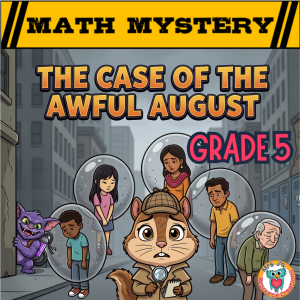
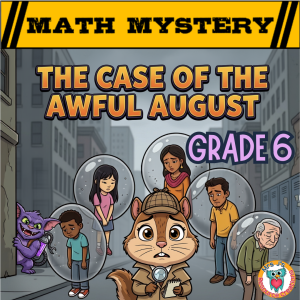
Case of the Awful August

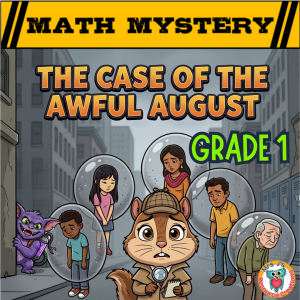
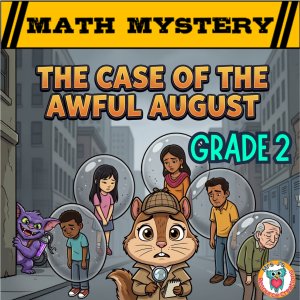
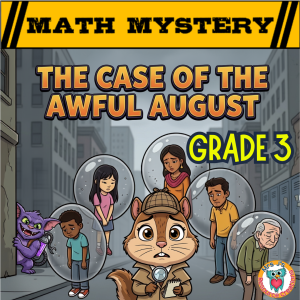
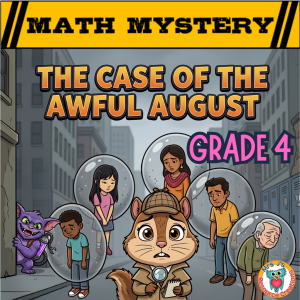
BACK TO SCHOOL MATH MYSTERY! The joy-stealing Grumble Gremlin is turning Mathhattan dull and dreary. Watch the video hook, then solve the math clues to find the one true antidote and make August amazing again. Begin clue one and solve the Case of the Awful August!

Who it’s for and how to use it: This short video hook is made for grades 1-6 classrooms and homeschools. Play it on your whiteboard or screen at the start of the lesson to set the scene, then hand out the grade-level case file. Students solve five math clue worksheets and use each answer to rule out possibilities until the case is solved. I recommend giving one clue at a time. It works well for math centers, spiral review, early finishers, homework, or the sub tub.

Math skills by grade

  • 1st grade: addition within 10 (solving simple addition equations to reveal the first clue), subtracting within 10 (solving basic subtraction equations), missing numbers (filling in the blank for a counting sequence up to 22), comparing numbers (which is bigger?) (identifying the larger whole number in a given pair), comparing numbers (which is smaller?) (identifying the smaller whole number in a given pair)
  • 2nd grade: addition & subtraction within 20, place value (tens and ones), odd and even numbers, tell and write time (o’clock and half-past only), repeated addition (arrays with visuals)
  • 3rd grade: addition & subtraction review (2-digit & 3-digit with gentle regrouping), place value up to 1,000 (standard, expanded, and word form), comparing numbers (identifying larger 2-digit & 3-digit numbers), tell and write time (to the nearest 5 minutes), mental math (10/100 more and 10/100 less)
  • 4th grade: 3-digit addition & subtraction (review of equations with and without regrouping, including subtracting across zero), basic multiplication facts (fact fluency review for factors 1-12), comparing multi-digit numbers, basic division facts (inverse fact fluency review with unique quotients 1-14), multiplying by multiples of 10 (multiplying 1-digit numbers by friendly multiples of 10 using place value strategies)
  • 5th grade: multi-digit addition & subtraction (reviewing standard algorithms with 4, 5, and 6-digit numbers, including heavy regrouping and subtracting across multiple zeros), multi-digit multiplication (2-digit by 2-digit multiplication to test mastery of standard algorithms or area models), comparing decimals (identifying the larger decimal up to the hundredths place, testing place value attention to detail), equivalent fractions (simplifying proper fractions to their lowest terms), factors, multiples, prime & composite (solving number riddles by identifying GCF, LCM, multiples, and distinguishing between prime and composite numbers)
  • 6th grade: adding & subtracting decimals (reviewing decimal alignment up to the thousandths place, including subtracting from whole numbers and using placeholder zeros), long division (dividing 3- and 4-digit dividends by 2-digit divisors with zero remainders), comparing fractions (comparing proper fractions with unlike denominators, reinforcing the ability to find common denominators), order of operations, volume word problems (calculating the volume of rectangular prisms in real-world contexts using the standard volume formula)
  • 7th and 8th grade: no Awful August edition found in the store for these grades

Find the print and go worksheets for individual grades below:

FAQ

What is a math mystery video hook?
It is a short animated story that introduces the case before students start. It sets the scene and builds excitement, and then the math worksheets do the rest.

Which grades is the Case of the Awful August for?
There are separate editions for 1st through 6th grade. Each one uses the same story with different grade-level math, so you can pick the edition that fits your class.

How long does it take and how do I use it?
The time varies with your class and the grade edition, and it can be split across lessons one clue at a time. Show the video first, then students can work alone, in pairs, or in small groups.