Description
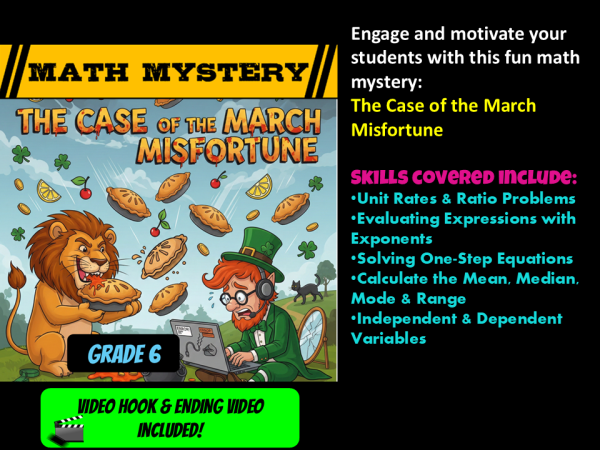
March Math Mystery 6th Grade: The Case of the March Misfortune is a no-prep March (St. Patrick’s Day) math review for 6th Grade students. Looking for a fun way to bring some “lucky” vibes to your math block without a full holiday focus? This 6th Grade math review uses basketballs, pies (Pi Day hints), and pots-of-gold themes to keep engagement high all month long, making it the perfect St. Patrick’s Day or March math activity to practice ratios, unit rates, exponents, equations, data and statistics, and independent and dependent variables. It is a targeted review of mid-year 6th Grade Common Core standards.
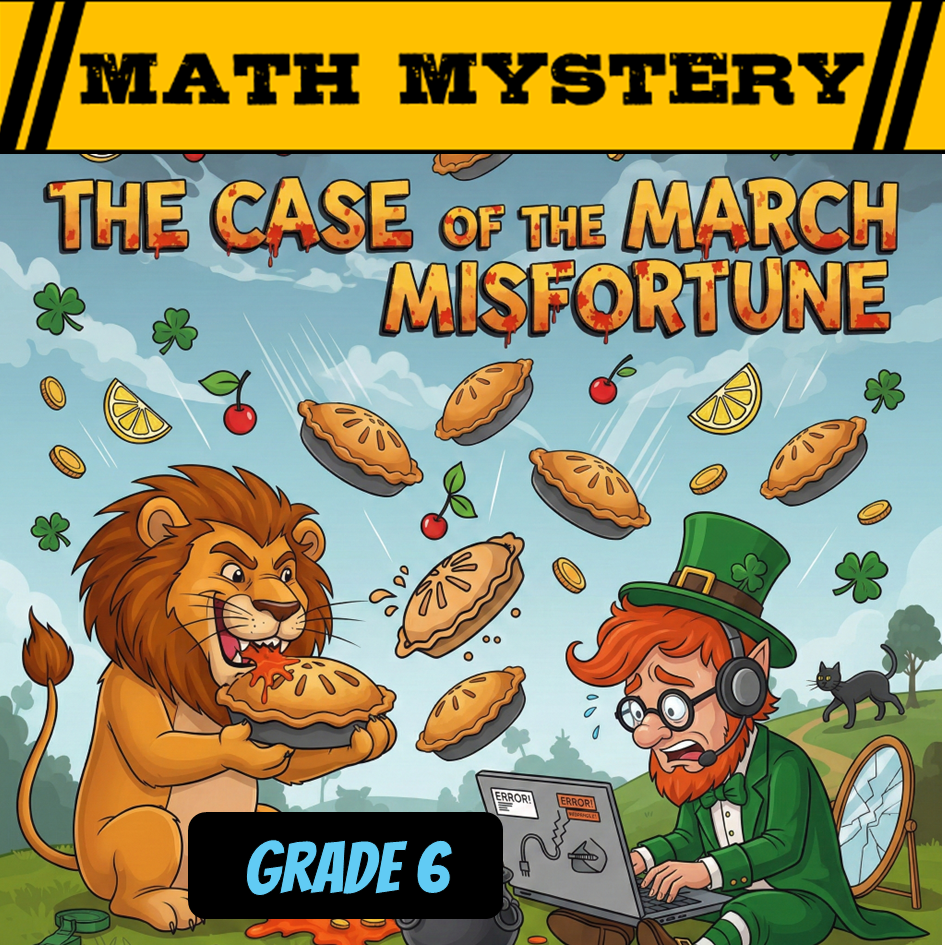
The Story: The Case of the March Misfortune
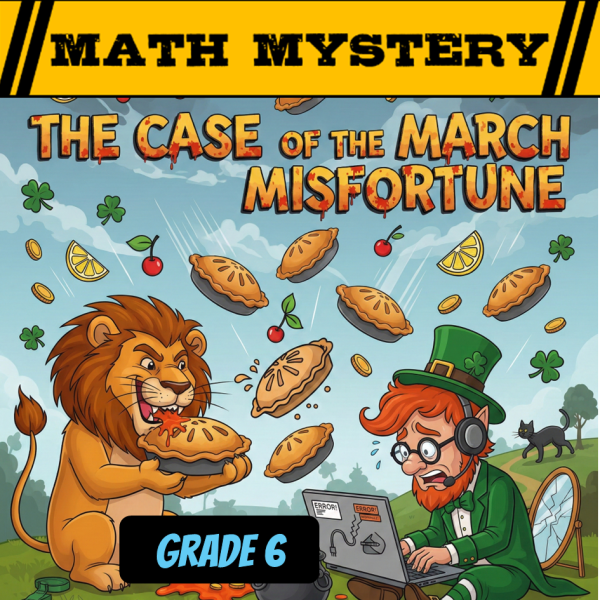
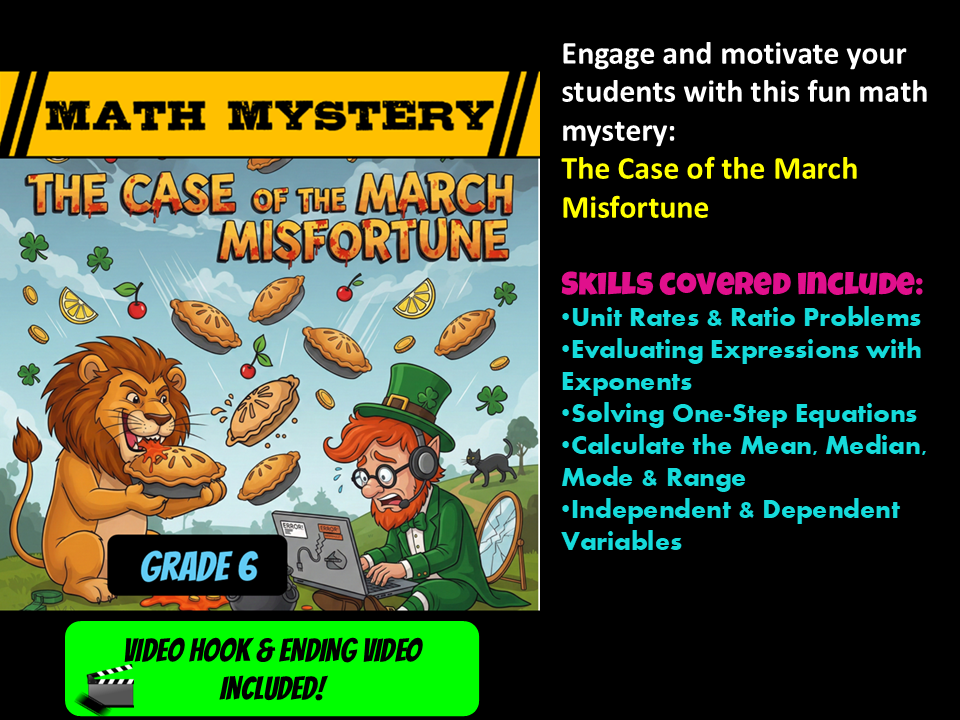
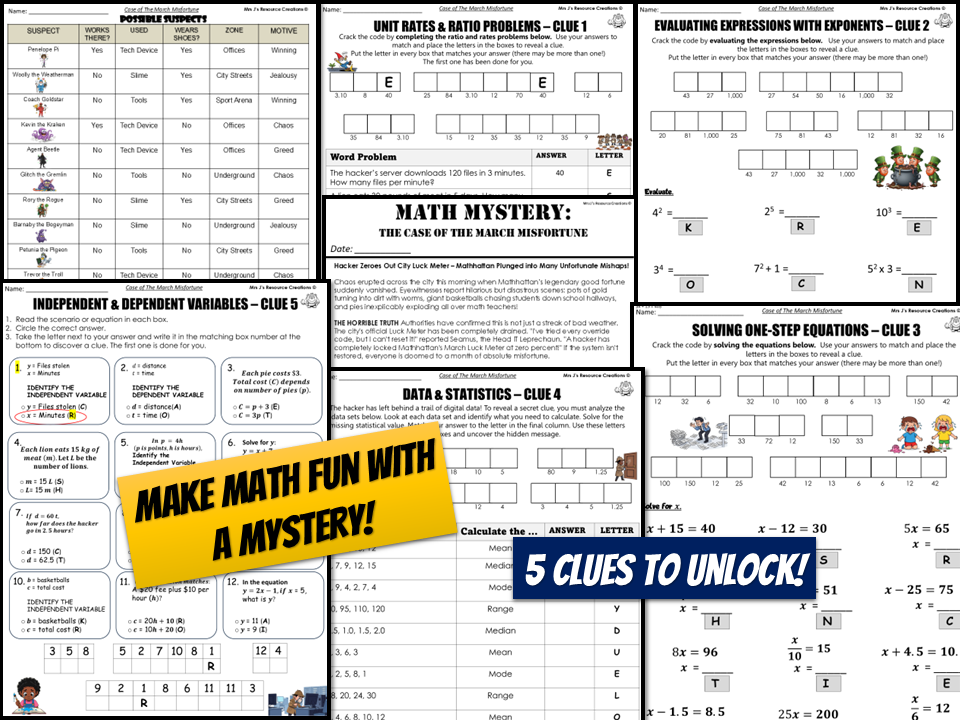
Someone has hacked Mathhattan’s Lucky Clover Luck Meter, and the city’s luck is in trouble! Students read the mystery story (or watch the video hook) about the hacker targeting the Lucky Clover luck meter, then complete five math worksheets to unlock clues. Each clue helps them eliminate suspects until only the culprit remains. Basketballs, pies (Pi Day hints), and pots of gold keep the theme “lucky” all month long, without a full holiday focus.
Set the scene with the optional video hook for the Case of the March Misfortune on your whiteboard or screen, then wrap up the case with the ending video. Students solve the math worksheets to unlock clues and eliminate possibilities after each clue to crack the case.
Math Skills Required to Unlock Clues
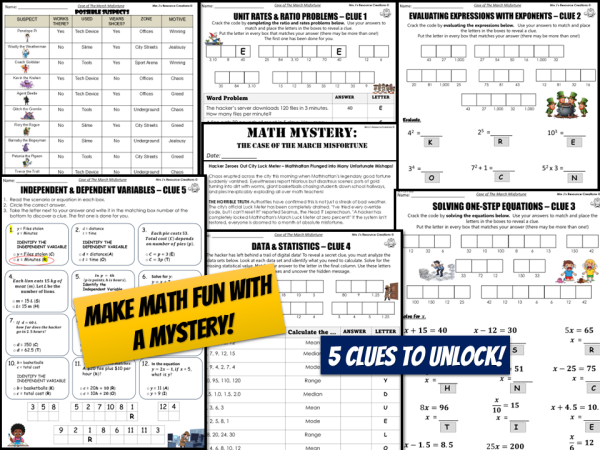
There are five clues to crack to solve the mystery:
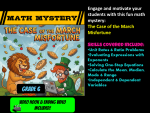
- Clue 1: Unit Rates & Ratio Problems
- Clue 2: Evaluating Expressions with Exponents
- Clue 3: Solving One-Step Equations
- Clue 4: Calculate the Mean, Median, Mode, & Range
- Clue 5: Independent & Dependent Variables
Students must use critical thinking skills to work out what each clue is telling them to eliminate from the list of possibilities.
What is Included in this Math Mystery?
- Optional video hook to introduce the case (watch it here).
- Ending video (with voiceovers) to wrap up the case.
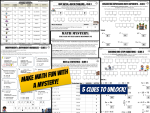
- Printable PDF case file: the mystery story, suspect list, and five clue worksheets.
- Google Slides digital version: 100% paperless. Assign it in Google Classroom. (Students must be in edit mode to type.)
- Printable awards to celebrate your students as Lead Detectives!
- Complete answer key.
Easy prep: Print the student pages, staple or place them in a folder, and your students are ready to start. Or assign the digital version for a paperless option. For Google Slides, students use edit mode (not slideshow mode) to enter their answers. The video can be shown on the smart board, a tablet, or a computer. No extra props or setup are needed.
March Math Mystery 6th Grade: Who It Is For
This edition is written for 6th Grade students and works all through March and around St. Patrick’s Day. Use it for:
- March math centers
- A St. Patrick’s Day “lucky” math review
- Spiral review or test prep
- A Fun Friday activity
- Sub tubs (easy prep!)
Pacing and Timing: Time to complete will vary anywhere between 30 minutes and 2 hours or more. It mainly depends on how familiar your students are with the math mystery format, and how difficult they find the math skills covered in the clues. Please check the skills above to help determine suitability for your class.
I recommend pacing this activity by giving students one clue at a time. Once the whole class has completed a clue, move on to the next clue, either within the same lesson or in the next math session. New math content presented? Make a lesson out of it by modeling the math before diving into the clue. I like to say, “We must learn something new before attempting the next clue.”
Why Teachers Love It
- Easy prep: just print and solve!
- Self-checking: the “Crack the Code” format lets students self-correct as they work.
- High engagement: even reluctant mathematicians love solving the mystery. It feels like a game, but there is lots of math practice and consolidation involved.
- Effortless assessment: a detailed answer key is included, and the “Crack the Code” format lets you check progress at a glance. If the code is correct, the math is correct.
You may also like:
Easy Grade-Level Differentiation
The Case of the March Misfortune is available in 6 grade editions. The story is the same; the math is different, so you can match each group to its level:
The 2nd-6th Grade editions can “clue swap” between editions to differentiate within one class. Grade 1 Math Mysteries are formatted for early learners and cannot be clue-swapped with the other grade versions. Read more: How to differentiate using Math Mysteries.
More St. Patrick’s Day and March Math for 6th Grade
Skills and Common Core Standards
- 6.RP.A.3b – Solve unit rate problems including those involving unit pricing and constant speed (unit rates and ratio problems (Clue 1))
- 6.EE.A.1 – Write and evaluate numerical expressions involving whole-number exponents (evaluating expressions with exponents (Clue 2))
- 6.EE.B.7 – Solve real-world and mathematical problems by writing and solving equations of the form x + p = q and px = q (solving one-step equations (Clue 3))
- 6.SP.B.5c – Give quantitative measures of center (median and/or mean) and variability (mean, median, mode, and range (Clue 4))
- 6.EE.C.9 – Use variables to represent two quantities in a real-world problem that change in relationship to one another; write an equation to express one quantity, the dependent variable, in terms of the other quantity, the independent variable (independent and dependent variables (Clue 5))
Looking for more? The Case of the March Misfortune is part of the 6th Grade Math Mystery Bundle, if you’d like a full set of resources in one place.
Not sure what a math mystery is? Read What is a Math Mystery? on my blog, or watch a short video about Math Mysteries.
Add extra motivation with the free Detective Rank Chart and Mystery Record. New to math mysteries? Try the free Case of the Super Bad Superhero first.
FAQ
How long will this activity take?
Time to complete varies between 30 minutes and 2 hours or more, depending on how familiar your students are with the math mystery format and how difficult they find the math skills. I recommend pacing it one clue at a time.
Is it self-checking?
Yes. The “Crack the Code” format lets students self-correct: if the code is correct, the math is correct. A detailed answer key is also included.
Is an answer key included?
Yes. A complete answer key is included, along with printable awards.
Can I use this with other grades?
Yes. The Case of the March Misfortune comes in 6 grade editions with the same story and different math, so you can match the edition to your students.
Technical issues? See my Troubleshooting Tips and FAQ page, or email me at jjresourcecreations@gmail.com.
For more ideas, activities, and resources, follow my store to stay updated on new releases. We can also stay connected via:
Thank you!
Jacqui J.
Mrs. J’s Resource Creations
Only logged in customers who have purchased this product may leave a review.




Reviews
There are no reviews yet.