Math Trick for Kids: The Always 2 Mind Reader
Looking for another quick math trick to hook your students at the start of a lesson? This classic mental math puzzle feels like magic to kids, but it is an easy, powerful way to sneak in extra arithmetic practice while reinforcing algebraic thinking.
No matter what starting number your students choose—whether it is 3, 50, or 500—the final answer to this math trick will always be 2!
Because the target answer never changes, it serves as an automatic self-checking task. If a student finishes with any answer other than 2, they immediately know a calculation slip occurred along the way and can retrace their steps to debug their work.
How the Math Trick Works
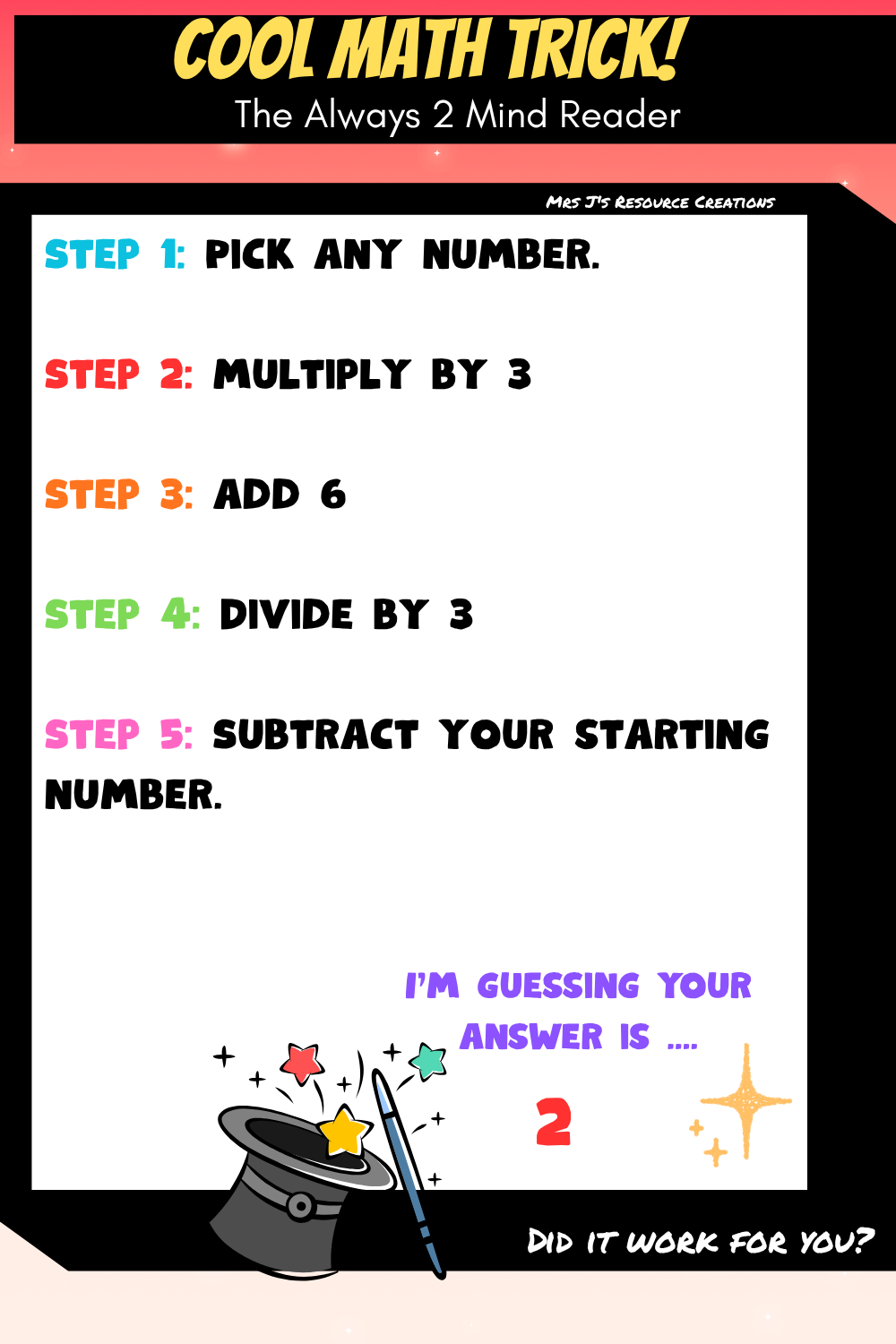
Have your students grab a whiteboard or piece of scrap paper and follow these five simple steps:
-
Pick any number. (Example: 7)
-
Multiply by 3. (7 X 3 = 21)
-
Add 6. (21 + 6 = 27)
-
Divide by 3. (27 divided by 3 = 9)
-
Subtract your starting number. (9 – 7 =2)
Classroom Implementation Ideas
-
Quick Lesson Warm-Up: Display the steps on the smartboard when students enter class. Have everyone calculate silently on whiteboards and reveal their final answer on the count of three.
-
Peer Error Analysis: If a student does not arrive at 2, have them swap whiteboards with a partner to locate the exact step where the calculation slipped.
-
The “Can You Break It?” Challenge: Ask early finishers to test negative numbers, decimals, or massive numbers to discover if the trick ever fails.
The Math Behind the Magic
A fun extension activity for upper elementary and middle schoolers is challenging them to explain why the trick works. You can introduce algebraic modeling on the board using $n$ as the mystery starting number:
-
Start with any number: n
-
Multiply by 3: 3n
-
Add 6: 3n + 6
-
Divide by 3: 3n + 6/ 3 = n + 2
-
Subtract the original number: (n + 2) – n = 2
Because multiplying by 3 and dividing by 3 cancel each other out, the trick simply divides the added number by 3 (6 divided by 3 = 2). Once students see the structure, challenge them to design their own trick that always equals 3, 4, or 10!
Explore More Fun Math Warm-Ups
Keep the problem-solving momentum going with our other classroom-tested mind readers and activities: