Cookie Math: A Hands-On Number Pattern Activity for Kids
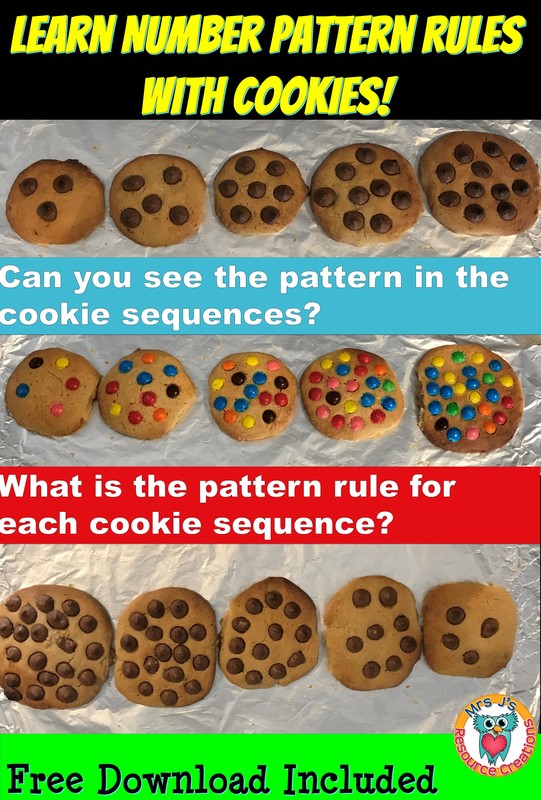
When I decided to bake some chocolate chip cookies, I thought, this could be a fun way to begin a unit on number patterns! This number pattern activity uses the chocolate chips on each cookie as the visual. Students look at a row of cookies, figure out how the number of chips changes, and come up with the pattern rule. It is hands-on, it is memorable, and yes, there may be a treat at the end.
Quick Answer: Use Cookies to Teach Pattern Rules
Line up cookies so the number of chocolate chips grows or shrinks by the same amount each time (for example 3, 5, 7, 9, 11). Ask students what they notice, guide them to find the rule (“add 2”), then have them draw the next three cookies and continue the sequence. Repeat with a harder pattern and less guidance each time. It works for kindergarten through 5th grade, and older students can extend shrinking patterns into negative numbers.
You can vary the difficulty of the number patterns to suit your class. Below are my instruction and questioning suggestions for three rounds of cookie patterns.
Round 1: How Do I Introduce a Number Pattern Activity With Cookies?
Display one row of cookies in a pattern sequence. I recommend plain chocolate chips (or anything all one color) for the first round, so the only thing that changes is the quantity.
Ask students to observe. Discuss what they see and steer them toward looking for a number pattern. Some guiding questions:
What do you notice about the cookies?
Can you see a pattern?
What is the pattern doing?
Collect observations. You may hear answers like “more chips are added to each cookie,” “there is an odd number of chips,” or “two extra chips are added each time.” All of these are great starting points.
Find the rule together. Ask (and guide if needed) whether they can come up with a rule for the pattern. Model your thinking out loud.
Think-aloud example: “There seems to be a growing number of chocolate chips on the cookies. It starts with 3, then 5, 7, 9, 11. The difference between each cookie is 2, so each time two more chips are added. The rule must be add 2.”
Round 2: Let Students Take the Lead
For my second batch I used mini M&M’s, because they are smaller and you can squeeze lots onto a single cookie. The colors may confuse some students, but that is also a fantastic challenge: who can look past the colors and see that the pattern is in the quantities?
Guide students through finding the pattern rule again, but with a little less help, to see if they are catching on to the thought process.
Then ask them to draw the next three cookies in the pattern.
Finally, have them write the next three numbers just by applying the rule.
Round 3: Can They Find the Rule on Their Own?
Depending on how the first two rounds went, just display the cookies this time and see if students can figure out the pattern rule independently and work out the next number in the sequence.
Teacher note: my third row was a shrinking pattern that starts at 20 chips and has the rule subtract 4. (Look closely: one chip on that first cookie is hanging off the bottom left edge. Baking is not one of my strengths. I must admit I got more excited about the math part!) With older or gifted students, challenge them to keep going past zero and dive into negative integers.
Free Printable: Learn Number Patterns with Cookies Worksheets
Want to skip the baking or keep the practice going? Grab my free Learn Number Patterns with Cookies worksheets (grades 2-5). The chocolate-chip cookies give students a visual way to work out the rule for a number pattern. Students build up to writing pattern rules on the first two cookie worksheets, then use the third page of empty cookies to create their own number patterns and write the rules.
Easy Ways to Extend the Activity
Create your own: students draw empty cookie circles on paper and design their own chocolate chip pattern for a partner to solve.
Competition: set a challenge to see who can figure out all the pattern rules first, or who can create the most interesting number pattern.
Grow the numbers: try add 5, add 10, or double-it patterns for older students.
No baking? Paper cookies with dot stickers, counters on paper plates, or a quick drawing on the board work just as well.
Super Easy Cookie Recipe for the Busy Teacher
Please check your school’s food and allergy policy before bringing treats into the classroom. Paper cookies are a great backup!
Ingredients
2 cups all-purpose (plain) flour
1 cup firmly packed brown sugar
2 eggs
200 g (about 14 tablespoons) butter, at room temperature
Lots of chocolate chips or mini M&M’s for your patterns
Steps
Preheat the oven to 350°F (180°C). Grease 2 baking trays with melted butter.
Use an electric mixer to beat the butter and sugar in a large bowl until creamy. Add the eggs one at a time, beating well after each one. Stir in the flour until combined, then use your hands to bring the dough together.
Roll 2-teaspoon portions of dough into balls and place them about 2 inches apart on the trays. Flatten slightly with a fork. If you plan to make patterns with large numbers, you may need to make your cookies a little bigger.
Arrange the chocolate chips on the cookies (I like to make one pattern per row on the tray). Bake for 18 minutes or until golden and just cooked through. Let them cool on the trays for 10 minutes.
My cookies were very rushed (a 3-year-old and an 8-month-old around my legs in the kitchen makes it a little challenging), but the kids did not mind one bit!
More Number Pattern Practice: The Case of the Poisonous Pizzas
Looking for more fun ways to practice number patterns? Try my Patterns Math Mystery, The Case of the Poisonous Pizzas. It comes with a video introduction to hook your students into the activity:
Choose your grade edition to see the pattern skills covered in each: 1st grade, 2nd grade, 3rd grade, 4th grade, and 5th grade. The clues are interchangeable if you need to differentiate for your students.
A pattern rule tells you how to get from one number in a sequence to the next, such as “add 2” or “subtract 4.” Once students know the rule, they can predict any number that comes next.
What grade is this cookie number pattern activity for?
It suits kindergarten to 5th grade. Use simple growing patterns with small numbers for younger students, and larger steps, shrinking patterns, or negative numbers for older students.
Do I have to bake real cookies?
No. Paper cookies with dot stickers, counters on paper plates, or drawings on the board work just as well, and they are a good choice if your school has food or allergy rules. My free Learn Number Patterns with Cookies worksheets are another no-bake option.
Why use chocolate chips of one color first?
When every chip looks the same, students focus only on how many there are. Mixed colors, like mini M&M’s, are a great second challenge because students must look past the colors to find the number pattern.
How can I make the activity harder for advanced students?
Use shrinking patterns and ask students to continue past zero into negative integers, try larger rules such as add 5 or double it, or have them create their own cookie pattern for a partner to solve.
Thank you for reading, and happy baking (and pattern hunting) with your class!